
Reading Without a Pen
On annotation, immersion, and trusting the way I read
The Cafe and the Unused Stylus
I am practically hopping as I climb down the stairs of my home and reach my bike parked in the shed. I am carrying my fancy olive green backpack that I bought specifically for my artist dates involving writing and reading, so that I can easily carry my laptop, e-reader, and notebook wherever I go. I even decorated it with cute enamel pins to make it my own and attached a brown leather coin purse for effect. I had a smile on my face when I started my bike and opened Google Maps.
I reached the cafe in twenty-three minutes, to be exact. I saw that it was 10:45 am. I placed an order for hot chocolate and picked a corner chair and table. I sat down to survey the cafe. It was very spacious and had warm lighting. The cafe smelled like biscuits and coffee. I saw that there were already a few other people who were working or having breakfast.
I extracted the e-reader and the green pen case, which had my stylus, from the backpack. I opened my e-reader and clicked on The Man Who Died Twice from the recently read list. And before you start to wonder, yes, it is a murder mystery. Again. Mysteries have always been my comfort reading, something I wrote about in Order in Chaos: Reading Agatha Christie When I Was Failing. It was a sequel to The Thursday Murder Club, which I had read two years ago and loved. I never got around to reading the sequel until now.
I took the stylus out of my pen case and placed it on the table so I could easily reach for it.
My hot chocolate had arrived, and I started taking slow, deliberate sips from it. I read page after page, so engrossed that I did not even realise I had finished my hot chocolate by half.
It was just when Elizabeth was expressing her displeasure with DCI Chris Hudson over his inability to catch the person who attacked her friend Ibrahim that I looked at my stylus lying on the table, still untouched.
I felt a pinch of guilt. But I got back to the book.
I don’t even remember how many pages I had turned by the time I finished my drink. I did not even look up once from the e-reader.
I had my lunch in the afternoon and a strawberry milkshake two and a half hours after that. I felt deep satisfaction as the book was slowly progressing.
It was 5 pm when I decided to leave.
I had not even annotated a single line.
But when I looked at how many pages I had finished reading, I had a feeling of quiet pleasure.
I looked at the stylus that lay on the table. I had bought it to read more deeply.
But something about it interfered with the way I naturally read.
I put my e-reader and stylus back in my backpack and started the journey back home.
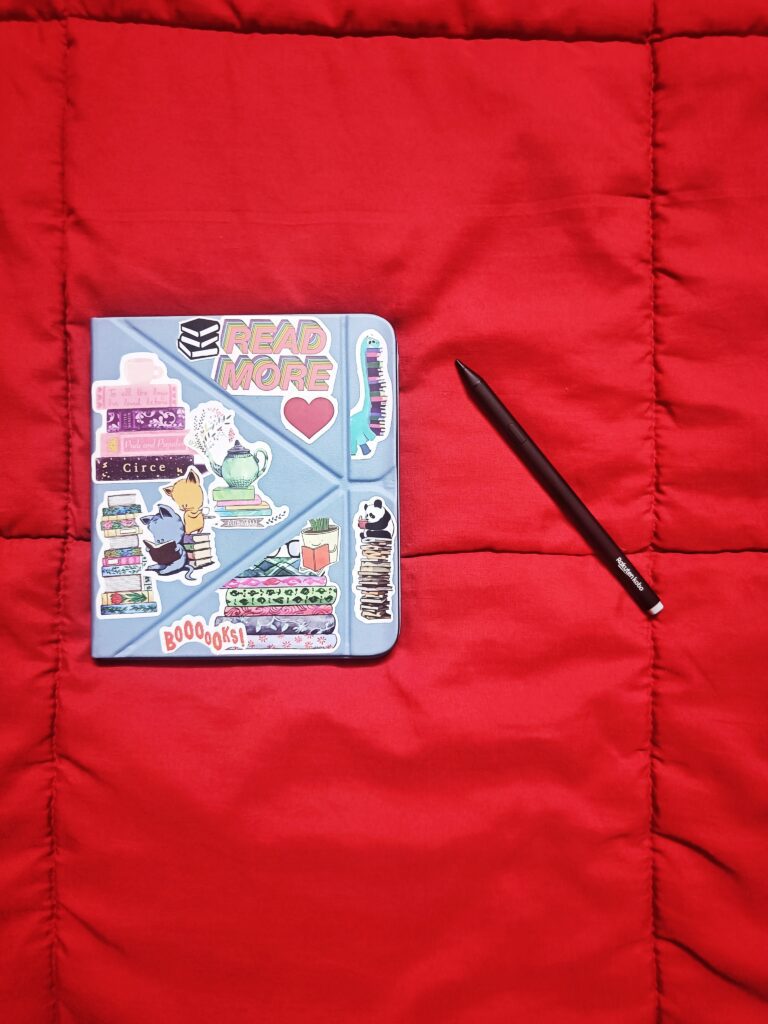
The Attempt to Annotate
It was 2 pm on a Wednesday. The afternoon sun ushered itself in through the window behind my chair in the clinic. I was wearing pink scrubs that day. I wear scrubs to work every day because they are practical, extremely comfortable, and reduce decision-making fatigue in the morning.
I was sitting in my chair, the e-reader propped on the metal stand I used for both it and the tablet, on the desk before me. It was a slow afternoon. The patient inflow dramatically decreases every day after 2 pm.
My stylus lay just beside the stand. It had been two months since I bought the stylus, but I had not annotated a single line with it yet.
I was determined to change that today.
I was reading Money Works. I had already finished two chapters. I was reading the section where the author was explaining how important it is to change our mindset if we are to take care of our money respectfully. I thought that he was making some brilliant points.
I tore myself away from the page, picked up my stylus, and underlined the point about how we should always pay ourselves first.
I now start overthinking about how two of the apples that I bought yesterday turned out to be rotten in one or two places. I started thinking whether the shopkeeper had sneaked them into the pack on purpose or if it was an honest mistake. My mother told me several times to properly check each and every fruit that goes into the bag, but of course, I trusted people too much to do that.
I mentally smack my head and remind myself to check everything properly the next time.
I then look towards the page I had been reading and see the newly annotated line.
I hadn’t even realised when I had stopped reading.
I stopped trying to annotate after that. Because I realised it wasn’t making me read more deeply; it was trying to make me read differently, not in the way that worked for me.
I don’t need to mark what mattered to me.
It stays anyway.
A Quiet Resolution
The stylus still sits in my bag.
I annotate sometimes, but I do not force it now.
I was lying on my bed when I was reading I Know Where You Buried Your Husband. My warm orange night light was switched on in my room.
I closed the book after reading the last sentence on the last page.
There was not a single tab in the book.
I remember the friendship between the women. How they protected each other, how they refused to be diminished by the men who tried to control them. The solidarity, the defiance, and how they chose each other.
I thought about getting the stylus from my bag on the shelf. To mark something. To prove I had read thoughtfully.
But the book was already a part of me.
I did not need proof.
If this resonated, you might enjoy Letters From a Slow Writer, my occasional newsletter on autonomy, solitude, and living deliberately.

Aishwarya is a government doctor in Hyderabad and a personal essayist. She writes about solitude, money, books, and the quiet work of building a life on her own terms.